| title | Summary of Atomic Classes | |
|---|---|---|
| category | Java | |
| tag |
|
Atomic translates to "atomic" in Chinese. In chemistry, an atom is the smallest unit of matter and is indivisible in chemical reactions. In programming, Atomic refers to an operation that has atomicity, meaning the operation is indivisible and uninterruptible. Even when multiple threads are executing simultaneously, the operation either completes entirely or does not execute at all, and other threads will not see a partially completed state.
In simple terms, atomic classes are classes that have the characteristic of atomic operations.
The Atomic classes in the java.util.concurrent.atomic package provide a thread-safe way to operate on a single variable.
The Atomic classes rely on CAS (Compare-And-Swap) optimistic locking to ensure the atomicity of their methods without needing traditional locking mechanisms (such as synchronized blocks or ReentrantLock).
This article will only introduce the concept of Atomic classes; for specific implementation principles, you can read the article written by the author: Detailed Explanation of CAS.
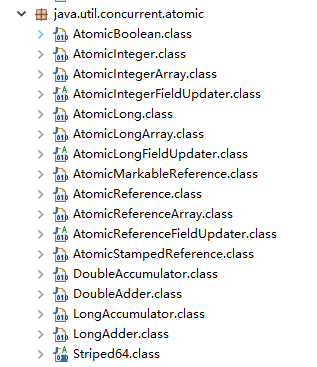
Based on the data types of the operations, the atomic classes in the JUC package can be divided into four categories:
1. Basic Types
Using atomic methods to update basic types
AtomicInteger: Integer atomic classAtomicLong: Long atomic classAtomicBoolean: Boolean atomic class
2. Array Types
Using atomic methods to update an element in an array
AtomicIntegerArray: Integer array atomic classAtomicLongArray: Long array atomic classAtomicReferenceArray: Reference type array atomic class
3. Reference Types
AtomicReference: Reference type atomic classAtomicMarkableReference: Atomic update of a reference type with a mark. This class associates a boolean mark with a reference,and can also solve the ABA problem that may occur when using CAS for atomic updates.AtomicStampedReference: Atomic update of a reference type with a version number. This class associates an integer value with a reference, which can be used to solve the atomic update of data and the version number of the data, and can address the ABA problem that may occur when using CAS for atomic updates.
🐛 Correction (see: issue#626): AtomicMarkableReference cannot solve the ABA problem.
4. Object Property Modification Types
AtomicIntegerFieldUpdater: Atomic updater for integer fieldsAtomicLongFieldUpdater: Atomic updater for long fieldsAtomicReferenceFieldUpdater: Atomic updater for fields in reference types
Using atomic methods to update basic types
AtomicInteger: Integer atomic classAtomicLong: Long atomic classAtomicBoolean: Boolean atomic class
The methods provided by the above three classes are almost identical, so we will use AtomicInteger as an example for introduction.
Common Methods of AtomicInteger:
public final int get() // Get the current value
public final int getAndSet(int newValue) // Get the current value and set a new value
public final int getAndIncrement() // Get the current value and increment it
public final int getAndDecrement() // Get the current value and decrement it
public final int getAndAdd(int delta) // Get the current value and add the expected value
boolean compareAndSet(int expect, int update) // If the input value equals the expected value, atomically set that value to the input value (update)
public final void lazySet(int newValue) // Eventually set to newValue; lazySet provides a weaker semantic than set, which may allow other threads to read the old value for a short period afterward, but may be more efficient.
Example of Using AtomicInteger:
// Initialize AtomicInteger object with an initial value of 0
AtomicInteger atomicInt = new AtomicInteger(0);

// Use getAndSet method to get the current value and set the new value to 3
int tempValue = atomicInt.getAndSet(3);
System.out.println("tempValue: " + tempValue + "; atomicInt: " + atomicInt);

// Use getAndIncrement method to get the current value and increment by 1
tempValue = atomicInt.getAndIncrement();
System.out.println("tempValue: " + tempValue + "; atomicInt: " + atomicInt);

// Use getAndAdd method to get the current value and add the specified value 5
temp