| title | Summary of Common Java Concurrency Interview Questions (Part 2) | ||||||||||||||
|---|---|---|---|---|---|---|---|---|---|---|---|---|---|---|---|
| category | Java | ||||||||||||||
| tag |
|
||||||||||||||
| head |
|
There are many important questions related to JMM (Java Memory Model), so I have dedicated a separate article to summarize the knowledge points and questions related to JMM: Detailed Explanation of JMM (Java Memory Model).
In Java, the volatile keyword can ensure the visibility of a variable. If we declare a variable as volatile, it indicates to the JVM that this variable is shared and unstable, and every time it is used, it will be read from the main memory.
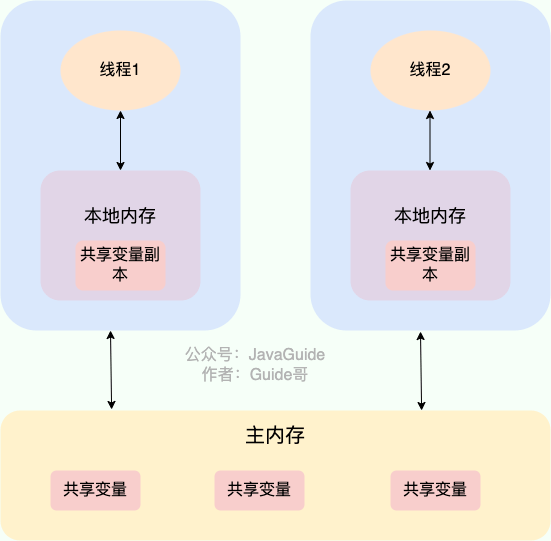
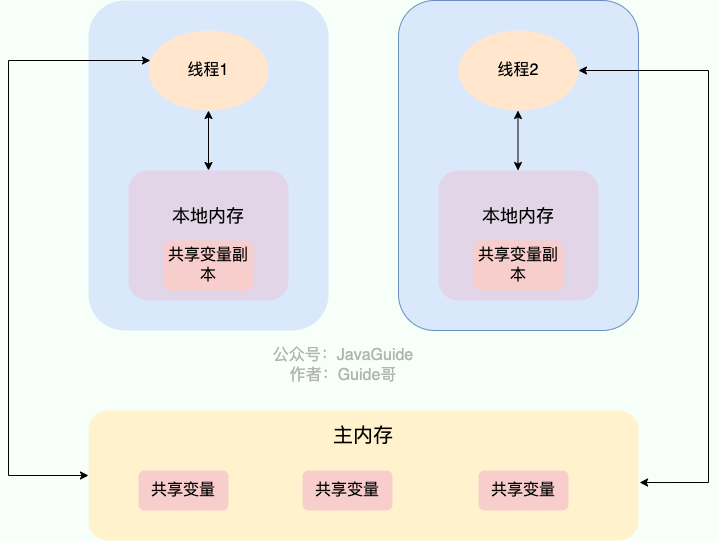
The volatile keyword is not unique to the Java language; it also exists in C. Its original meaning is to disable CPU caching. If we modify a variable with volatile, it indicates to the compiler that this variable is shared and unstable, and every time it is used, it will be read from the main memory.
The volatile keyword can ensure data visibility but cannot guarantee data atomicity. The synchronized keyword can guarantee both.
In Java, the volatile keyword not only ensures variable visibility but also plays an important role in preventing JVM instruction reordering. If we declare a variable as volatile, when performing read and write operations on this variable, specific memory barriers will be inserted to prevent instruction reordering.
In Java, the Unsafe class provides three out-of-the-box methods related to memory barriers, which shield the differences at the operating system level:
public native void loadFence();
public native void storeFence();
public native void fullFence();
Theoretically, you can achieve the same effect as volatile in preventing reordering using these three methods, but it would be more complicated.
Below, I will explain the effect of the volatile keyword in preventing instruction reordering using a common interview question.
Interviewers often ask: "Are you familiar with the singleton pattern? Please write it out for me! Explain the principle of implementing the singleton pattern using double-checked locking!"
Double-Checked Locking Implementation of Singleton (Thread-Safe):
public class Singleton {

    private volatile static Singleton uniqueInstance;

    private Singleton() {
    }

    public static Singleton getUniqueInstance() {
        // First check if the object has already been instantiated; only enter the locking code if it hasn't been instantiated
        if (uniqueInstance == null) {
            // Lock the class object
            synchronized (Singleton.class) {
                if (uniqueInstance == null) {
                    uniqueInstance = new Singleton();
                }
            }
        }
        return uniqueInstance;
    }
}
It is necessary to use the volatile keyword to modify uniqueInstance. The line uniqueInstance = new Singleton(); is actually executed in three steps:
- Allocate memory space for
uniqueInstance. - Initialize
uniqueInstance. - Point
uniqueInstanceto the allocated memory address.
However, due to the JVM's instruction reordering characteristics, the execution order may become 1->3->2. Instruction reordering does not pose a problem in a single-threaded environment, but in a multi-threaded environment, it can lead to one thread obtaining an instance that has not yet been initialized. For example, if thread T1 executes steps 1 and 3, and then thread T2 calls getUniqueInstance() and finds uniqueInstance is not null, it will return uniqueInstance, but at this point, uniqueInstance has not yet been initialized.
The volatile keyword can ensure variable visibility but cannot guarantee that operations on the variable are atomic.
We can prove this with the following code:
/**
 * Search for "JavaGuide" on WeChat to receive a free personal original Java interview manual
 *
 * @author Guide
 * @date 2022/08/03 13:40
 **/
public class VolatileAtomicityDemo {
    public volatile static int inc = 0;

    public void increase() {