| title | Detailed Explanation of ThreadLocal | |
|---|---|---|
| category | Java | |
| tag |
|
This article is a romantic submission from a branch of flowers. The original address: https://juejin.cn/post/6844904151567040519.

The full text contains over 10,000 words and 31 images. This article also took a considerable amount of time and effort to complete. Original works are not easy, so please show some support by liking and following. Thank you.
When it comes to ThreadLocal, everyone's first reaction might be that it's a simple thread-local variable copy that isolates each thread. However, here are a few questions for you to ponder:
- The
keyofThreadLocalis a weak reference. When callingThreadLocal.get(), does the key become null after a GC? - What are the data structures in
ThreadLocal'sThreadLocalMap? - What is the hash algorithm of
ThreadLocalMap? - How does
ThreadLocalMapresolve hash collisions? - What is the expansion mechanism of
ThreadLocalMap? - What is the cleanup mechanism for expired keys in
ThreadLocalMap? What are the processes of probe cleanup and heuristic cleanup? - What is the implementation principle of the
ThreadLocalMap.set()method? - What is the implementation principle of the
ThreadLocalMap.get()method? - How is
ThreadLocalused in projects? What pitfalls have been encountered? - ...
Have you mastered the above questions? This article will analyze every detail of ThreadLocal using images and text based on these questions.
Note: The source code in this article is based on JDK 1.8.
Let's first look at an example of using ThreadLocal:
public class ThreadLocalTest {
    private List<String> messages = Lists.newArrayList();

    public static final ThreadLocal<ThreadLocalTest> holder = ThreadLocal.withInitial(ThreadLocalTest::new);

    public static void add(String message) {
        holder.get().messages.add(message);
    }

    public static List<String> clear() {
        List<String> messages = holder.get().messages;
        holder.remove();

        System.out.println("size: " + holder.get().messages.size());
        return messages;
    }

    public static void main(String[] args) {
        ThreadLocalTest.add("Does a branch of flowers count as romantic?");
        System.out.println(holder.get().messages);
        ThreadLocalTest.clear();
    }
}
Output:
[Does a branch of flowers count as romantic?]
size: 0
The ThreadLocal object provides thread-local variables, where each Thread has its own copy variable, and multiple threads do not interfere with each other.

The Thread class has an instance variable threadLocals of type ThreadLocal.ThreadLocalMap, which means each thread has its own ThreadLocalMap.
ThreadLocalMap has its own independent implementation, where its key can simply be viewed as ThreadLocal, and value is the value placed in the code (in reality, the key is not the ThreadLocal itself, but a weak reference to it).
Whenever a thread places a value into ThreadLocal, it stores it in its own ThreadLocalMap, and reading is also done by using ThreadLocal as a reference to find the corresponding key in its own map, thereby achieving thread isolation.
ThreadLocalMap is somewhat similar to the structure of HashMap, except that HashMap is implemented using arrays + linked lists, while ThreadLocalMap does not have a linked list structure.
We also need to pay attention to Entry, where its key is ThreadLocal<?> k, inheriting from WeakReference, which is what we commonly refer to as weak reference types.
To address the question at the beginning, the key of ThreadLocal is a weak reference. So, when calling ThreadLocal.get(), is the key null after GC?
To clarify this, we need to understand Java's four types of reference:
- Strong Reference: The objects we usually create with
neware strong reference types. As long as the strong reference exists, the garbage collector will never reclaim the referenced object, even during memory shortage. - Soft Reference: Objects referenced by
SoftReferenceare considered soft references. These objects are collected when there is a risk of memory overflow. - Weak Reference: Objects referenced by
WeakReferenceare weak references. As soon as garbage collection occurs, if this object is only pointed to by a weak reference, it will be reclaimed. - Phantom Reference: Phantom references are the weakest references, defined in Java using
PhantomReference. The only function of a phantom reference is to receive notifications that the object is about to be reclaimed.
Next, let's look at the code. We will use reflection to check the data state in ThreadLocal after GC (the following code comes from: https://blog.csdn.net/thewindkee/article/details/103726942 local running demonstration of GC scenarios):
public class ThreadLocalDemo {

    public static void main(String[] args) throws NoSuchFieldException, IllegalAccessException, InterruptedException {
        Thread t = new Thread(() -> test("abc", false));
        t.start();
        t.join();
        System.out.println("--after gc--");
        Thread t2 = new Thread(() -> test("def", true));
        t2.start();
        t2.join();
    }

    private static void test(String s, boolean isGC) {
        try {
            new ThreadLocal<>().set(s);
            if (isGC) {
                System.gc();
            }
            Thread t = Thread.currentThread();
            Class<? extends Thread> clz = t.getClass();
            Field field = clz.getDeclaredField("threadLocals");
            field.setAccessible(true);
            Object ThreadLocalMap = field.get(t);
            Class<?> tlmClass = ThreadLocalMap.getClass();
            Field tableField = tlmClass.getDeclaredField("table");
            tableField.setAccessible(true);
            Object[] arr = (Object[]) tableField.get(ThreadLocalMap);
            for (Object o : arr) {
                if (o != null) {
                    Class<?> entryClass = o.getClass();
                    Field valueField = entryClass.getDeclaredField("value");
                    Field referenceField = entryClass.getSuperclass().getSuperclass().getDeclaredField("referent");
                    valueField.setAccessible(true);
                    referenceField.setAccessible(true);
                    System.out.println(String.format("Weak reference key: %s, value: %s", referenceField.get(o), valueField.get(o)));
                }
            }
        } catch (Exception e) {
            e.printStackTrace();
        }
    }
}
The result is as follows:
Weak reference key: java.lang.ThreadLocal@433619b6, value: abc
Weak reference key: java.lang.ThreadLocal@418a15e3, value: java.lang.ref.SoftReference@bf97a12
--after gc--
Weak reference key: null, value: def
As shown in the figure, because the ThreadLocal created here does not point to any value, i.e., there are no references:
new ThreadLocal<>().set(s);So, after GC, the key will be reclaimed. We see from the above debug that referent=null. If we modify the code slightly:

Initially looking at this problem, if you don’t think too much about it, with weak reference and garbage collection, you may definitely feel it should be null.
However, this is incorrect, because the scenario describes that the ThreadLocal.get() operation is being performed, which indicates that a strong reference is still present, hence the key is not null, as shown in the following figure, the strong reference of ThreadLocal is still present.

If our strong reference does not exist, then the key will be reclaimed, which leads to value never being reclaimed, and the key being reclaimed results in memory leakage.

The principle of the set method in ThreadLocal is depicted in the diagram above. It’s quite simple: it mainly checks if ThreadLocalMap exists and then uses the set method in ThreadLocal to process the data.
The code is as follows:
public void set(T value) {
    Thread t = Thread.currentThread();
    ThreadLocalMap map = getMap(t);
    if (map != null)
        map.set(this, value);
    else
        createMap(t, value);
}

void createMap(Thread t, T firstValue) {
    t.threadLocals = new ThreadLocalMap(this, firstValue);
}
The key logic is still in ThreadLocalMap, which we will analyze in detail later.
Since it's a Map structure, ThreadLocalMap certainly needs to implement its own hash algorithm to address the issue of collision in the hash table array.
int i = key.threadLocalHashCode & (len - 1);The hash algorithm in ThreadLocalMap is quite simple; here i is the index position of the current key in the hash table.
The most crucial aspect is the calculation of the threadLocalHashCode value. The ThreadLocal contains a property HASH_INCREMENT = 0x61c88647.
public class ThreadLocal<T> {
    private final int threadLocalHashCode = nextHashCode();

    private static AtomicInteger nextHashCode = new AtomicInteger();

    private static final int HASH_INCREMENT = 0x61c88647;

    private static int nextHashCode() {
        return nextHashCode.getAndAdd(HASH_INCREMENT);
    }

    static class ThreadLocalMap {
        ThreadLocalMap(ThreadLocal<?> firstKey, Object firstValue) {
            table = new Entry[INITIAL_CAPACITY];
            int i = firstKey.threadLocalHashCode & (INITIAL_CAPACITY - 1);

            table[i] = new Entry(firstKey, firstValue);
            size = 1;
            setThreshold(INITIAL_CAPACITY);
        }
    }
}
Every time a ThreadLocal object is created, the value of ThreadLocal.nextHashCode increases by 0x61c88647.
This value is quite special; it is a Fibonacci number, also known as the golden ratio. The hash increment of this number ensures that the hash is evenly distributed.
We can try it out:

The generated hash codes are distributed very evenly. We won't go into the specifics of the Fibonacci algorithm here; interested readers can look up related materials themselves.
Note: In all example images below, green blocks represent normal data, gray blocks represent
Entrywithkeyvalue ofnull, having been garbage collected. White blocks indicateEntryisnull.
Although ThreadLocalMap uses the golden ratio as a factor for hash computation, greatly reducing the probability of hash collisions, conflicts may still occur.
HashMap resolves conflicts by constructing a linked list structure in the array. Conflicting data is appended to the list, and if the list length exceeds a certain number, it is transformed into a red-black tree.
However, ThreadLocalMap does not have a linked list structure, so we cannot use the HashMap method for conflict resolution.

As shown in the diagram above, when we insert data with value=27, it is calculated to fall into slot 4, but slot 4 already has Entry data.
At this point, a linear search will occur, continuing until an Entry with a value of null is found to stop searching, placing the current element in that slot. Of course, there are other scenarios during the iteration, such as encountering an entry where key is equal or an Entry where key is null, etc., all of which will have different treatments that will be explained later.
There is also data in Entry whose key is null (the gray block data of Entry=2). Since the key is a weak reference type, such data may exist. During the set process, if an expired Entry is encountered, a round of probe cleanup will actually occur, and the specific operation will be discussed later.
After understanding the hash algorithm of ThreadLocal, let's look at how set is implemented.
Setting data in ThreadLocalMap (either adding or updating data) can be divided into several scenarios, which we will explain with illustrations.
Scenario One: The slot corresponding to the key calculated by hash is empty:

Here, the data can be placed directly into that slot.
Scenario Two: The slot data is not empty, and the key value matches the current ThreadLocal obtained through hash calculation:

Here, the data in the slot is updated directly.
Scenario Three: The slot data is not empty, and during the subsequent traversal, before finding an Entry with a value of null, an expired Entry is not encountered:

In this case, iterate through the hash array and perform a linear search. If an Entry with a value of null is found in the slot, place the data there or update directly upon encountering an equal key during the search.
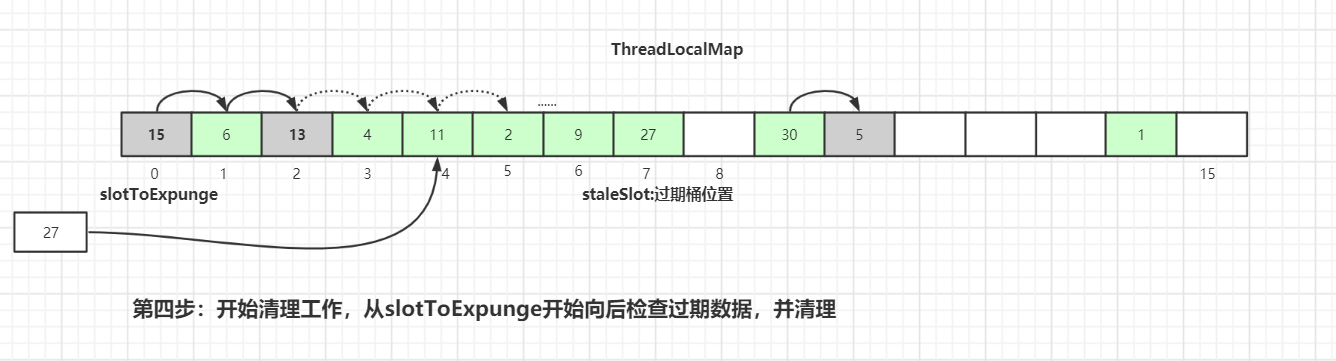
Scenario Four: The slot data is not empty, and during the subsequent traversal, an expired Entry is encountered before finding an Entry with a value of null. For example, if an expired data Entry is at index=7:

The slot at array index 7 has Entry data with a key of null, indicating that the key has already been garbage collected. At this point, the replaceStaleEntry() method will be executed, which is the logic for replacing expired data, starting the search at index=7 for probing cleanup.
To initialize the scanning start position for probing cleanup for expired data: slotToExpunge = staleSlot = 7
Starting from the current staleSlot, iterate forward to find other expired data, and update the starting scan index slotToExpunge. The for loop will iterate until it encounters an Entry with a value of null.
If expired data is found, continue iterating until discovering an Entry with a value of null to stop the iteration, as shown in the diagram below; slotToExpunge gets updated to 0:

Iterating forward from the current node (index=7), check for expired Entry data. If it is found, update the value of slotToExpunge. Stop probing when encountering null. In this example, slotToExpunge was updated to 0.
The mentioned forward iteration operation's purpose is to update the value of slotToExpunge, which will serve later to determine whether there are any expired elements before the current stale slot.
Next, begin iterating backward from the staleSlot position (index=7); if an Entry with the same key value is found:

Search for Entry elements with an equal key value starting from the current node staleSlot. If found, update the value of Entry and swap with the staleSlot element (the staleSlot location is the expired element); update the Entry data and initiate cleanup for expired Entry, as shown in the diagram:
Entry with the same key value is found:

Continue searching for an Entry with the same key value from the current staleSlot until reaching a slot with Entry set as null to stop searching. As seen in the above diagram, there are no Entry values with the same key.
Create a new Entry to replace the position of table[stableSlot]:

Once the replacement is complete, also run the expired elements cleanup operation, primarily two methods: expungeStaleEntry() and cleanSomeSlots(). We will cover the specifics later, so please keep reading.
Having illustrated the principles of set() with diagrams, it's already quite clear. Let’s delve into the source code:
java.lang.ThreadLocal.ThreadLocalMap.set():
private void set(ThreadLocal<?> key, Object value) {
    Entry[] tab = table;
    int len = tab.length;
    int i = key.threadLocalHashCode & (len - 1);

    for (Entry e = tab[i];
         e != null;
         e = tab[i = nextIndex(i, len)]) {
        ThreadLocal<?> k = e.get();

        if (k == key) {
            e.value = value;
            return;
        }

        if (k == null) {
            replaceStaleEntry(key, value, i);
            return;
        }
    }

    tab[i] = new Entry(key, value);
    int sz = ++size;
    if (!cleanSomeSlots(i, sz) && sz >= threshold)
        rehash();
}
This method calculates the corresponding position in the hash table based on the key, then iteratively looks for an available bucket starting from the current key's position.
Entry[] tab = table;
int len = tab.length;
int i = key.threadLocalHashCode & (len - 1);
When is a bucket usable?
- If
k = key, it indicates this is a replacement operation. - If a bucket containing an expired
Entryis encountered, replace it with new logic. - When encountering a bucket whose
Entryisnull.
Next in the loop:
- If the
Entrydata at the current bucket corresponding tokeyisnull, this indicates no data conflict. Break out of the loop and set data directly into this bucket. - If the
Entrydata at the current bucket corresponding tokeyis not empty:
2.1 Ifk = key, it signifies the currentsetoperation is for replacement. Execute the replacement logic and return.
2.2 Ifkey = null, signifying that the current bucket’sEntrycontains expired data, invokereplaceStaleEntry()(the core method) before returning. - If the loop concludes without finding the
key, create anew Entryobject in the bucket withEntryset tonull. - After that, invoke
cleanSomeSlots()to carry out heuristic cleanup of expired keys in the hash table. If no data was cleaned, and size exceeds the threshold (two-thirds of array length), proceed torehash().
Next, closely review the replaceStaleEntry() method, which provides the functionality to replace expired data. You can relate it to the principle diagram in Scenario Four provided earlier:
java.lang.ThreadLocal.ThreadLocalMap.replaceStaleEntry():
private void replaceStaleEntry(ThreadLocal<?> key, Object value,
                                       int staleSlot) {
    Entry[] tab = table;
    int len = tab.length;
    Entry e;

    int slotToExpunge = staleSlot;
    for (int i = prevIndex(staleSlot, len);
         (e = tab[i]) != null;
         i = prevIndex(i, len))

        if (e.get() == null)
            slotToExpunge = i;

    for (int i = nextIndex(staleSlot, len);
         (e = tab[i]) != null;
         i = nextIndex(i, len)) {

        ThreadLocal<?> k = e.get();

        if (k == key) {
            e.value = value;

            tab[i] = tab[staleSlot];
            tab[staleSlot] = e;

            if (slotToExpunge == staleSlot)
                slotToExpunge = i;
            cleanSomeSlots(expungeStaleEntry(slotToExpunge), len);
            return;
        }

        if (k == null && slotToExpunge == staleSlot)
            slotToExpunge = i;
    }

    tab[staleSlot].value = null;
    tab[staleSlot] = new Entry(key, value);

    if (slotToExpunge != staleSlot)
        cleanSomeSlots(expungeStaleEntry(slotToExpunge), len);
}
The slotToExpunge indicates the start index for probing cleanup of expired data, initially starting at the staleSlot. The search continues from staleSlot, iterating forward to find non-expired data to potentially update slotToExpunge. The for loop iterates until encountering an Entry that is null.
for (int i = prevIndex(staleSlot, len);
     (e = tab[i]) != null;
     i = prevIndex(i, len)){

    if (e.get() == null){
        slotToExpunge = i;
    }
}
Next, the search from staleSlot indices forward occurs, and when encountering a key equal to the passed key, the element is replaced and swap positions.
if (k == key) {
    e.value = value;
    tab[i] = tab[staleSlot];
    tab[staleSlot] = e;

    if (slotToExpunge == staleSlot)
        slotToExpunge = i;

    cleanSomeSlots(expungeStaleEntry(slotToExpunge), len);
    return;
}
If k != key, continue searching forward in the probing process. If k == null, then the currently checked Entry is expired, indicating a potential update for slotToExpunge.
if (k == null && slotToExpunge == staleSlot)
    slotToExpunge = i;
When no matching k == key is found, but an Entry becomes null, the addition operation occurs where a new Entry is created for the table[staleSlot].
tab[staleSlot].value = null;
tab[staleSlot] = new Entry(key, value);
Finally, if slotToExpunge differs from staleSlot, cleanup operations begin anew.
if (slotToExpunge != staleSlot)
cleanSomeSlots(expungeStaleEntry(slotToExpunge), len);Above, we mentioned the two cleanup methods for expired keys in ThreadLocalMap: probing cleanup and heuristic cleanup.
We first discuss probing cleanup, specifically in the expungeStaleEntry method, which iterates through the hash array, probing and cleaning expired data, setting the value of the Entry to null. If a non-expired bucket is encountered, the values will be relocated.

In the diagram, set(27) is calculated to be in index=4; since it already has data, it will continue iterating forward, leading to data being moved to index=7. After a while, the Entry data at index=5 key becomes null.

When additional set operations to map occur, this will trigger probing cleanup.
After this operation, expired data will be cleaned up, and non-expired data will be recalled after capturing the appropriate hash key slot position more properly.
Next, let’s see the specific flow of expungeStaleEntry(). We adopt the principle-then-source-code approach to explain step by step.

Assume calling expungeStaleEntry(3) leads to the following observations, showcasing the data situation in ThreadLocalMap:

The first step clears the current staleSlot, changing the index=3 data to null. The probing continues forward:

After completing Step 2, the index=4 data is moved到 the index=3 slot.
As the iteration proceeds to verify whether normal data encounters an offset at an appropriate position.

The traversal continues; upon encountering an empty slot, it terminates the probing cleanup while confirming that this round of cleaning is complete. This completes a round of probing cleanup work, and now we can view the implementation in detail:
private int expungeStaleEntry(int staleSlot) {
    Entry[] tab = table;
    int len = tab.length;

    tab[staleSlot].value = null;
    tab[staleSlot] = null;
    size--;

    Entry e;
    int i;
    for (i = nextIndex(staleSlot, len);
         (e = tab[i]) != null;
         i = nextIndex(i, len)) {
        ThreadLocal<?> k = e.get();
        if (k == null) {
            e.value = null;
            tab[i] = null;
            size--;
        } else {
            int h = k.threadLocalHashCode & (len - 1);
            if (h != i) {
                tab[i] = null;

                while (tab[h] != null)
                    h = nextIndex(h, len);
                tab[h] = e;
            }
        }
    }
    return i;
}
Using staleSlot=3 as an example, the process starts by clearing the data at tab[staleSlot], and then the value of size decreases.
Next to confirm if the value has expired, indicating a mark for cleaning.
ThreadLocal<?> k = e.get();

if (k == null) {
    e.value = null;
    tab[i] = null;
    size--;
}
If the key is still valid, its corresponding (Entrys)` index will be calculated allowing the relevant data to be relocated in the table.
int h = k.threadLocalHashCode & (len - 1);
if (h != i) {
    ...
}
The only way for correct data to avoid hash collisions will be to ensure it has been relocated at the most nearby possible point.
At the conclusion of ThreadLocalMap.set(), if after running the heuristic cleanup, no data has been cleaned and the current number of Entrys exceeds a threshold of (len*2/3), the method begins the rehash() logic:
if (!cleanSomeSlots(i, sz) && sz >= threshold)
    rehash();
To comprehend, let's investigate how rehash() is specifically implemented:
private void rehash() {
    expungeStaleEntries();

    if (size >= threshold - threshold / 4)
        resize();
}

private void expungeStaleEntries() {
    Entry[] tab = table;
    int len = tab.length;
    for (int j = 0; j < len; j++) {
        Entry e = tab[j];
        if (e != null && e.get() == null)
            expungeStaleEntry(j);
    }
}
The first step entails performing a probing cleanup for stale entries, iterating through table forwards. Following the cleanup, if size >= threshold - threshold / 4 (which is equivalent to size >= threshold * 3/4), this indicates a need to expand.
Be sure to make the distinction when discussing ThreadLocalMap's expansion mechanism; note both steps.

Next, looking at the specific implementation of resize() for clarity, we'll use an example with oldTab.len=8:

With the new tab size being oldLen * 2, an iteration over the former has the hash positioning recalculated, effectively moving all existing data into the newly generated tab. The subsequent threshold for re-expansion will be recalculated accordingly.
private void resize() {
    Entry[] oldTab = table;
    int oldLen = oldTab.length;
    int newLen = oldLen * 2;
    Entry[] newTab = new Entry[newLen];
    int count = 0;

    for (int j = 0; j < oldLen; ++j) {
        Entry e = oldTab[j];
        if (e != null) {
            ThreadLocal<?> k = e.get();
            if (k == null) {
                e.value = null;
            } else {
                int h = k.threadLocalHashCode & (newLen - 1);
                while (newTab[h] != null)
                    h = nextIndex(h, newLen);
                newTab[h] = e;
                count++;
            }
        }
    }

    setThreshold(newLen);
    size = count;
    table = newTab;
}Now that we’ve completed examining the set() method source code, which consists of setting and cleaning data operations as well, the next step is to look into the principles behind the get() operation.
Scenario One: When the key value is lookup based on hash in the slot position, if the Entry.key matches the key, return immediately:

Scenario Two: If the Entry.key differs from the intended key value:

Assuming we use get(ThreadLocal1), if calculation via hash indicates the correct slot is index 4 but that slot contains data where the key property doesn’t match ThreadLocal1, we will need to continue searching.
Upon reaching data in index=5, if Entry.key=null, this activates a probe cleanup, invoking expungeStaleEntry() method while iterating stops at encountering any remaining Entry as null.
After cleaning, we can continue considering the next slot; if we maintain searching through for matching key values, we will eventually arrive back to entry with a matching key.
java.lang.ThreadLocal.ThreadLocalMap.getEntry():
private Entry getEntry(ThreadLocal<?> key) {
    int i = key.threadLocalHashCode & (table.length - 1);
    Entry e = table[i];
    if (e != null && e.get() == key)
        return e;
    else
        return getEntryAfterMiss(key, i, e);
}

private Entry getEntryAfterMiss(ThreadLocal<?> key, int i, Entry e) {
    Entry[] tab = table;
    int len = tab.length;

    while (e != null) {
        ThreadLocal<?> k = e.get();
        if (k == key)
            return e;
        if (k == null)
            expungeStaleEntry(i);
        else
            i = nextIndex(i, len);
        e = tab[i];
    }
    return null;
}We’ve previously mentioned two cleanup methods for expired keys in ThreadLocalMap: probe cleanup (expungeStaleEntry()) and heuristic cleanup (cleanSomeSlots()).
Probationary cleanup is specific about the current Entry being cleaned in succession until the null values finally stop.
Heuristic cleanup, however, has been defined as: Heuristically scan some cells looking for stale entries.

The specific code is as follows:
private boolean cleanSomeSlots(int i, int n) {
    boolean removed = false;
    Entry[] tab = table;
    int len = tab.length;
    do {
        i = nextIndex(i, len);
        Entry e = tab[i];
        if (e != null && e.get() == null) {
            n = len;
            removed = true;
            i = expungeStaleEntry(i);
        }
    } while ((n >>>= 1) != 0);
    return removed;
}When we use ThreadLocal, in asynchronous scenarios, child threads cannot share the thread-local copies of data created in parent threads.
To address this problem, JDK provides the InheritableThreadLocal class. Let’s see an example:
public class InheritableThreadLocalDemo {
    public static void main(String[] args) {
        ThreadLocal<String> threadLocal = new ThreadLocal<>();
        InheritableThreadLocal<String> inheritableThreadLocal = new InheritableThreadLocal<>();
        threadLocal.set("Parent data: threadLocal");
        inheritableThreadLocal.set("Parent data: inheritableThreadLocal");

        new Thread(new Runnable() {
            @Override
            public void run() {
                System.out.println("Child thread gets parent ThreadLocal data: " + threadLocal.get());
                System.out.println("Child thread gets parent inheritableThreadLocal data: " + inheritableThreadLocal.get());
            }
        }).start();
    }
}
Output:
Child thread gets parent ThreadLocal data: null
Child thread gets parent inheritableThreadLocal data: Parent data: inheritableThreadLocal
The implementation principle is that child threads are initialized through the parent thread by calling the new Thread() method. The Thread#init method within the Thread constructor is invoked at this point, during which parent thread data is copied over to the child thread:
private void init(ThreadGroup g, Runnable target, String name,
                      long stackSize, AccessControlContext acc,
                      boolean inheritThreadLocals) {
    if (name == null) {
        throw new NullPointerException("name cannot be null");
    }

    if (inheritThreadLocals && parent.inheritableThreadLocals != null)
        this.inheritableThreadLocals =
            ThreadLocal.createInheritedMap(parent.inheritableThreadLocals);
    this.stackSize = stackSize;
    tid = nextThreadID();
}
However, InheritableThreadLocal still has drawbacks, as asynchronous processing typically utilizes thread pools; InheritableThreadLocal is set during the init() method under new Thread, meaning potential concerns arise regarding thread reuse.
Fortunately, when issues arise, solutions surface. Alibaba has open-sourced a TransmittableThreadLocal component, which resolves this problem. Those interested may consult additional resources.
In our project, logging is done using ELK + Logstash, with Kibana employed for display and retrieval.
Currently, services deploy distributed systems providing services externally; inter-project call relationships can be linked via traceId. However, how should traceId be transferred between different projects?
Here we employ org.slf4j.MDC to achieve this, which is implemented internally via ThreadLocal. The specific execution is as follows:
When the frontend sends a request to Service A, Service A generates a traceId string akin to UUID, placing it into the current thread's ThreadLocal. In calling Service B, this traceId is inserted into the request's headers; upon Service B receiving the request, it first examines whether the request’s headers contain traceId, and if present, it writes it into its own thread’s ThreadLocal.

In the diagram, requestId represents our traceId associated with different system chains, enabling mutual calls. This also permits additional scenarios:

For these scenarios, we can devise appropriate solutions, as outlined below.
Service Sending Request:
@Component
@Slf4j
public class FeignInvokeInterceptor implements RequestInterceptor {

    @Override
    public void apply(RequestTemplate template) {
        String requestId = MDC.get("requestId");
        if (StringUtils.isNotBlank(requestId)) {
            template.header("requestId", requestId);
        }
    }
}
Service Receiving Request:
@Slf4j
@Component
public class LogInterceptor extends HandlerInterceptorAdapter {

    @Override
    public void afterCompletion(HttpServletRequest arg0, HttpServletResponse arg1, Object arg2, Exception arg3) {
        MDC.remove("requestId");
    }

    @Override
    public void postHandle(HttpServletRequest arg0, HttpServletResponse arg1, Object arg2, ModelAndView arg3) {
    }

    @Override
    public boolean preHandle(HttpServletRequest request, HttpServletResponse response, Object handler) throws Exception {
        String requestId = request.getHeader(BaseConstant.REQUEST_ID_KEY);
        if (StringUtils.isBlank(requestId)) {
            requestId = UUID.randomUUID().toString().replace("-", "");
        }
        MDC.put("requestId", requestId);
        return true;
    }
}Since MDC is implemented based on ThreadLocal, during asynchronous execution, child threads cannot access data stored in the parent thread's ThreadLocal. Therefore, we can add a customized thread pool executor and modify the run() method:
public class MyThreadPoolTaskExecutor extends ThreadPoolTaskExecutor {

    @Override
    public void execute(Runnable runnable) {
        Map<String, String> context = MDC.getCopyOfContextMap();
        super.execute(() -> run(runnable, context));
    }

    @Override
    private void run(Runnable runnable, Map<String, String> context) {
        if (context != null) {
            MDC.setContextMap(context);
        }
        try {
            runnable.run();
        } finally {
            MDC.remove();
        }
    }
}A custom attribute named requestId is added to the message body in MQ. Upon consumer retrieval of the message, they can decode and utilize requestId at will.