| title | Overview of Java 9 New Features | |
|---|---|---|
| category | Java | |
| tag |
|
Java 9 was released on September 21, 2017. As a new version released three and a half years after Java 8, Java 9 brought many significant changes. The most important change is the introduction of the Java Platform Module System, along with other features such as collections, Stream, and more.
You can download the JDK version you need at Archived OpenJDK General-Availability Releases! The official documentation for new features is available at: https://openjdk.java.net/projects/jdk/.
Overview (Selected Highlights):
- JEP 222: Java Command-Line Tools
- JEP 261: Modular System
- JEP 248: G1 Becomes the Default Garbage Collector
- JEP 193: Variable Handles
- JEP 254: String Storage Structure Optimization
JShell is a new utility added in Java 9. It provides a real-time command-line interactive tool for Java, similar to Python.
You can directly input expressions in JShell and view their execution results.
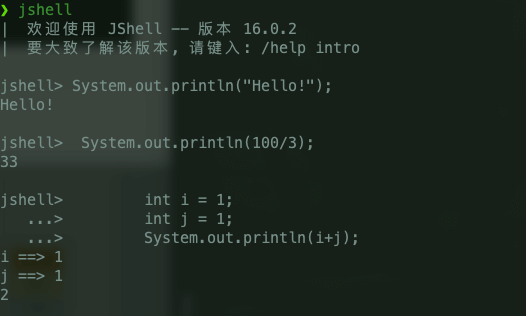
What benefits does JShell bring us?
- It lowers the barrier for outputting the first line of Java's "Hello World!" and enhances the learning enthusiasm of beginners.
- It is more efficient than an IDE when handling simple logic or validating small problems (not intended to replace an IDE; for complex logic verification, an IDE is more suitable. Both are complementary).
- …
How does JShell's code differ from ordinary compilable code?
- Once a statement is input, JShell immediately returns the execution result without requiring an editor, compiler, or interpreter.
- JShell supports the re-declaration of variables, with the latter declaration overriding the former.
- JShell supports standalone expressions, such as a simple addition operation
1 + 1. - …
The module system is part of the Jigsaw Project and introduces modular development practices into the Java platform, allowing for better code reusability!
What is the module system? The official definition is:
A uniquely named, reusable group of related packages, as well as resources (such as images and XML files) and a module descriptor.
In simple terms, you can think of a module as a uniquely named, reusable group of packages, resources, and a module descriptor file (module-info.java).
Any JAR file can be upgraded to a module by adding a module descriptor file (module-info.java).
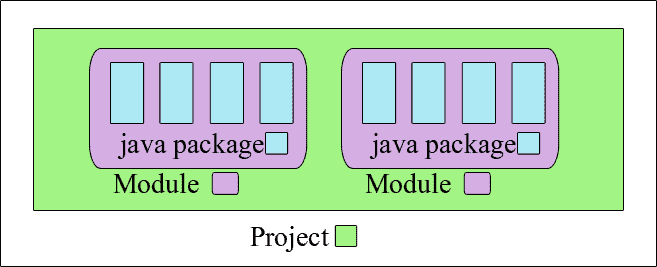
After the introduction of the module system, the JDK was reorganized into 94 modules. Java applications can create custom runtime images that include only the JDK modules they depend on using the new jlink tool (Jlink is a new command-line tool released with Java 9 that allows developers to create their own lightweight, customized JRE for modular Java applications), which can greatly reduce the size of the Java runtime environment.
We can precisely control which classes can be exposed for external use and which classes can only be used internally with the exports keyword.
module my.module {
    //exports public members of specified packages
    exports com.my.package.name;
}

module my.module {
     //exports…to restrict the accessibility of members
    export com.my.package.name to com.specific.package;
}
To learn more about Java 9's modular system, you can refer to the following articles:
- “Project Jigsaw: Module System Quick-Start Guide”
- “Java 9 Modules: Part 1”
- Java 9 Revealed (2. Modular System) here
In Java 8, the default garbage collector was Parallel Scavenge (for young generation) + Parallel Old (for old generation). In Java 9, the CMS garbage collector was deprecated, and G1 (Garbage-First Garbage Collector) became the default garbage collector.
G1 was introduced in Java 7 and became the default garbage collector after outstanding performance in two versions.
Factory methods such as List.of(), Set.of(), Map.of(), and Map.ofEntries() were added to create immutable collections (somewhat inspired by Guava):
List.of("Java", "C++");
Set.of("Java", "C++");
Map.of("Java", 1, "C++", 2);
Collections created using of() are immutable and cannot be modified (e.g., adding, removing, replacing, sorting, etc.), otherwise a java.lang.UnsupportedOperationException will be thrown.
In versions prior to Java 9, String was stored using char[]. After Java 9, the implementation of String changed to use byte[] to store strings, saving space.
public final class String implements java.io.Serializable, Comparable<String>, CharSequence {
    // @Stable annotation indicates that the variable can be modified at most once, known as "stable".
    @Stable
    private final byte[] value;
}Java 9 allows private methods in interfaces. This makes the usage of interfaces more flexible, akin to a simplified abstract class.
public interface MyInterface {
    private void methodPrivate(){
    }
}Before Java 9, we could only declare variables within the try-with-resources block:
try (Scanner scanner = new Scanner(new File("testRead.txt"));
    PrintWriter writer = new PrintWriter(new File("testWrite.txt"))) {
    // omitted
}
After Java 9, effectively-final variables can be used in try-with-resources statements.
final Scanner scanner = new Scanner(new File("testRead.txt"));
PrintWriter writer = new PrintWriter(new File("testWrite.txt"))
try (scanner; writer) {
    // omitted
}
What is an effectively-final variable? In simple terms, it is a variable that is not declared as final but has not changed since its initialization.
As demonstrated in the code above, even though the writer variable was not explicitly declared as final, it will not change after it is first assigned a value, thus it is an effectively-final variable.
New methods such as ofNullable(), dropWhile(), takeWhile(), and an overloaded version of the iterate() method have been added to Stream.
The ofNullable() method in Java 9 allows us to create a single-element Stream that may contain a non-null element or an empty Stream. In Java 8, it was not possible to create an empty Stream.
Stream<String> stringStream = Stream.ofNullable("Java");
System.out.println(stringStream.count());// 1
Stream<String> nullStream = Stream.ofNullable(null);
System.out.println(nullStream.count());//0
The takeWhile() method can sequentially retrieve elements from a Stream that meet a condition, stopping when the condition is no longer satisfied.
List<Integer> integerList = List.of(11, 33, 66, 8, 9, 13);
integerList.stream().takeWhile(x -> x < 50).forEach(System.out::println);// 11 33
The dropWhile() method has the opposite effect of takeWhile().
List<Integer> integerList2 = List.of(11, 33, 66, 8, 9, 13);
integerList2.stream().dropWhile(x -> x < 50).forEach(System.out::println);// 66 8 9 13
The new overloaded method of iterate() provides a Predicate parameter (a condition) to determine when to stop iterating.
public static<T> Stream<T> iterate(final T seed, final UnaryOperator<T> f) {
}
// The newly added overloaded method
public static<T> Stream<T> iterate(T seed, Predicate<? super T> hasNext, UnaryOperator<T> next) {

}
The usage comparison between the two methods is as follows; the new iterate() overloaded method is more flexible.
// Using the original iterate() method to output numbers 1~10
Stream.iterate(1, i -> i + 1).limit(10).forEach(System.out::println);
// Using the new iterate() overloaded method to output numbers 1~10
Stream.iterate(1, i -> i <= 10, i -> i + 1).forEach(System.out::println);
The Optional class has new methods ifPresentOrElse(), or(), and stream().
The ifPresentOrElse() method takes two parameters, Consumer and Runnable. If the Optional is non-empty, it calls the Consumer parameter; if it is empty, it calls the Runnable parameter.
public void ifPresentOrElse(Consumer<? super T> action, Runnable emptyAction)

Optional<Object> objectOptional = Optional.empty();
objectOptional.ifPresentOrElse(System.out::println, () -> System.out.println("Empty!!!"));// Empty!!!
The or() method accepts a Supplier parameter, and if the Optional is empty, it returns the Optional value specified by the Supplier parameter.
public Optional<T> or(Supplier<? extends Optional<? extends T>> supplier)

Optional<Object> objectOptional = Optional.empty();
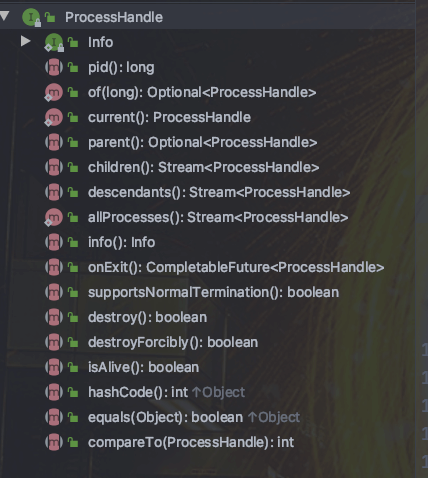
objectOptional.or(() -> Optional.of("java")).ifPresent(System.out::println);//javaJava 9 introduces the java.lang.ProcessHandle interface for managing native processes, particularly suitable for managing long-running processes.
// Get the currently running JVM process
ProcessHandle currentProcess = ProcessHandle.current();
// Output the process id
System.out.println(currentProcess.pid());
// Output the process information
System.out.println(currentProcess.info());
Overview of the ProcessHandle interface:
In Java 9, the java.util.concurrent.Flow class added the core interfaces of the reactive streams specification.
Flow includes four core interfaces: Flow.Publisher, Flow.Subscriber, Flow.Subscription, and Flow.Processor. Java 9 also provides SubmissionPublisher as an implementation of Flow.Publisher.
For a more detailed interpretation of Java 9's reactive streams, you can check out the article Java 9 Revealed (17. Reactive Streams) - Lin Bendo.
Variable handles provide a reference to a variable or a group of variables, including static fields, non-static fields, array elements, and components in off-heap data structures.
The meaning of variable handles is similar to the existing MethodHandle. They are represented by the Java class java.lang.invoke.VarHandle, and VarHandle objects can be created using static factory methods in the class java.lang.invoke.MethodHandles.Lookup.
The introduction of VarHandle replaces some operations of java.util.concurrent.atomic and sun.misc.Unsafe. It also provides a set of standard memory barrier operations for finer-grained control of memory ordering, offering superior security, usability, and performance compared to existing APIs.
- Platform Logging API Improvements: Java 9 allows for the same logging implementation for both the JDK and applications. A new
System.LoggerFinderhas been introduced to manage the logging implementations used by the JDK. The JVM only has one system-wideLoggerFinderinstance at runtime. We can add our ownSystem.LoggerFinderimplementations to enable the JDK and applications to use logging frameworks like SLF4J. - Enhancements in
CompletableFutureClass: Several new methods (completeAsync,orTimeout, etc.) have been added. - Enhancements to Nashorn Engine: Nashorn is a JavaScript engine introduced from Java 8. Java 9 made some enhancements to Nashorn to implement some new ES6 features (which have been deprecated in Java 11).
- New Features for I/O Streams: New methods have been added to read and copy data contained in
InputStream. - Improved Application Security: Java 9 introduced four SHA-3 hash algorithms: SHA3-224, SHA3-256, SHA3-384, and SHA3-512.
- Improved Method Handles: Method handles were introduced from Java 7, and Java 9 added more static methods in the
java.lang.invoke.MethodHandlesclass to create different types of method handles. - …
- Java version history: https://en.wikipedia.org/wiki/Java_version_history
- Release Notes for JDK 9 and JDK 9 Update Releases: https://www.oracle.com/java/technologies/javase/9-all-relnotes.html
- "In-Depth Analysis of Java New Features" - Geek Time - JShell: How to Quickly Validate Simple Problems?
- New Features in Java 9: https://www.baeldung.com/new-java-9
- Java – Try with Resources: https://www.baeldung.com/java-try-with-resources