Title: CSS Rhythmic Sizing
Shortname: css-rhythm
Level: 1
Group: CSSWG
Status: ED
Work Status: exploring
Editor: Koji Ishii, Google, kojiishi@gmail.com, w3cid 45369
Editor: Elika J. Etemad / fantasai, Invited Expert, http://fantasai.inkedblade.net/contact, w3cid 35400
ED: https://drafts.csswg.org/css-rhythm/
TR: https://www.w3.org/TR/css-rhythm-1/
Abstract: This module contains CSS features for aligning content size
  to multiple of unit size.
spec:css21; type:property; text:max-height
spec:css21; type:property; text:max-width
spec:css21; type:property; text:min-width
spec:css-writing-modes-4; type:dfn; text:end
spec:css-writing-modes-4; type:dfn; text:start
spec:css-break-3; type:dfn; text:fragment
Introduction {#intro}
=====================
This specification provides features to control sizes of CSS objects
according to the rules desired by use cases.
Controlling sizes of CSS objects to be multiple of a unit
is desired in many cases.
This level of the specification focuses on following cases.
* Adjust heights of block-level boxes to multiples of the specified length.
* Adjust heights of line boxes to multiples of the specified length.
By stacking blocks at multiples,
authors can align content across columns, pages, scroll-snapped bocks
or multiple blocks placed absolutely
to maintain vertical rhythm.
Also by controlling heights of line boxes,
lines of text in different fonts can create consistent visuals
to help readability.
East Asian Casual Vertical Rhythms {#eastasia}
----------------------------------------------
In East Asia, a casual variant of vertical rhythm is widely used.
Vertical rhythm is typically used in professional typography.
While it improves readability,
its spacing constraints require careful and well-thought design of spaces.
The East Asian casual variant was
originally a product of technical constraints of traditional word processors in '80s.
But when the technical constraints were lifted in more modern technologies,
with the help of square-like visual of ideographic characters,
East Asian authors preferred to keep parts of the characteristics.
In this variant of vertical rhythm,
the requirement is loosened for the ease of use for non-professional authors.
Text is still on the rhythm,
so that the majority of ideographic characters are mostly on grid,
but when author specifies borders, margins, or some other objects that may break the rhythm,
the rhythm is shifted rather than forced.
The strict vertical rhythm often surprises non-professional authors by forced jumps in such cases,
while this variant combines rhythm on text and the ease of use for non-professional authors.
This variant was very widely accepted in East Asia since the middle of '90s,
such that most major word processors used in East Asia provided similar features
by default.
In East Asian publishing typography,
the vertical rhythm is one of important properties,
but its priority compared to other properties
varies by types of documents.
In single column documents,
the priority is weaker than that of multi-column documents.
Text should be on the vertical rhythm,
but it is often preferred for borders, margins,
or other properties to win over the rhythm.
In such cases, the rhythm is shifted, similar to the casual variant.
In this specification,
when the 'line-height-step' property is used without combination of the 'block-step' property
or the 'line-grid' property,
it produces the similar effect as the East Asian casual vertical rhythm.
It may also serve good for East Asian publishing typography,
depends on the desired strength of the vertical rhythm.
For other cases of vertical rhythm,
it is expected that
the 'block-step' property or the 'line-grid' property are used,
or that the 'line-height-step' property is used together with them.
Adjusting Block-level Box Heights {#block-height}
=================================
The most common typographic rhythm problems are block-level intrusions:
when continuous paragraph-level text is interrupted
by differently-sized content such as illustrations and headings,
then the line-to-line rhythm can be thrown off.
The block step properties allow such elements
to be fitted to the rhythmic interval
by constraining their height to a multiple of a specified step size.
This allows content before and after the interruption
to maintain a continuous rhythm.
While consistent use of the block step properties
can produce the strictly gridded layout needed
for parallel content flows,
per-element specification of the step size
also allows some interruptions to take their natural size in the flow,
restarting the vertical rhythm afterwards.
This can be useful in single-column layouts
where the vertical rhythm is important to maintain visual continuity,
but there is nothing alongside to align to.
In these casese,
large interruptions which visually disconnect the flow before and after
can prioritize optimal spacing around the item
over strict adherence to a continouous grid
(by specifying ''block-step: none'', the initial value).
ISSUE: This proposal can be simplified down to just the 'block-step-size' property, represented solely through its shortened form as 'block-step'.
This level will likely at most contain 'block-step-size' and 'block-step-insert', leaving 'block-step-align' and 'block-step-round' to be added if the future demands.
The full design is described herein for current discussion and future reference.
ISSUE: This proposal is currently defined to apply only to block-level boxes. This limitation is solely to simplify the first iteration; it should eventually be extended to all layout modes that honor specified heights.
Specifying the Step Size: the 'block-step-size' property {#block-step-size}
--------------------------------------------------------
	Name: block-step-size
	Value: none | <>
	Initial: none
	Applies to: block-level boxes
	Inherited: no
	Animatable: ???
	Percentages: N/A
	Media: visual
	Computed Value: keyword or absolute length
This property defines the step unit for a block-level box’s block size.
When the step unit is set to a positive <>,
the box’s outer height is rounded
(see 'block-step-round')
to the closest multiple of the unit.
Negative <> values are invalid.
Values other than ''block-step-size/none''
cause the box to establish a new formatting context.
In situations where margins collapse,
only the box’s own margin is considered
in calculating its outer size.
When a box fragments,
step sizing is applied per fragment.
Specifying the Spacing Type: the 'block-step-insert' property {#block-step-insert}
--------------------------------------------------------
	Name: block-step-insert
	Value: margin | padding
	Initial: margin
	Applies to: block-level boxes
	Inherited: no
	Animatable: no
	Percentages: N/A
	Media: visual
	Computed Value: as specified
This property specifies whether extra spacing
derived from applying 'block-step-size'
is inserted inside (like 'padding') or outside (like 'margin')
the box’s border.
Values have the following meanings:
- margin
-
Any extra space resulting from a 'block-step-size'-induced adjustment
is inserted outside the box’s border, as extra margin.
- padding
-
Any extra space resulting from a 'block-step-size'-induced adjustment
is inserted inside the box’s border, as extra padding.
Specifying Alignment: the 'block-step-align' property {#block-step-align}
-----------------------------------------------------
	Name: block-step-align
	Value: auto | center | start | end
	Initial: auto
	Applies to: block-level boxes
	Inherited: no
	Animatable: no
	Percentages: N/A
	Media: visual
	Computed Value: as specified
This property specifies whether extra spacing
derived from applying 'block-step-size'
is inserted before, inserted after, or split between both sides of the box.
Values have the following meanings:
- auto
-
If 'block-step-insert' is ''margin'':
if 'align-self' is ''start'', ''end'', or ''center'', treat as that value,
otherwise treat as ''center''.
- center
-
Any extra space resulting from a 'block-step-size'-induced adjustment
is split, and applied half on either side of the box.
- start
-
Any extra space resulting from a 'block-step-size'-induced adjustment
is inserted on the end side of the box.
- end
-
Any extra space resulting from a 'block-step-size'-induced adjustment
is inserted on the start side of the box.
In all cases,
additional spacing cannot be added to margins
that are truncated or omitted due to unforced fragmentation breaks
(see [[CSS3-PAGE]] and [[CSS-BREAK-3]]);
therefore if 'block-step-insert' is ''margin'',
all extra space derived from applying 'block-step-size'
must be inserted on the opposite side of the fragment
(regardless of 'block-step-align').
Rounding Method: the 'block-step-round' property {#block-step-round}
------------------------------------------------
	Name: block-step-round
	Value: up | down | nearest
	Initial: up
	Applies to: block-level boxes
	Inherited: no
	Animatable: no
	Percentages: N/A
	Media: visual
	Computed Value: as specified
This property specifies whether adjustments due to 'block-step-size'
insert positive or negative space.
Values have the following meanings:
- up
-
The outer size of the box is increased
(positive space is inserted)
to fulfill the 'block-step-size' constraint.
- down
-
The outer size of the box is decreased
(negative space is inserted)
to fulfill the 'block-step-size' constraint.
- nearest
-
The outer size of the box is either
increased (as for ''up'') or decreased (as for ''down''--
whichever results in the smallest absolute change--
to fulfill the 'block-step-size' constraint.
If both options would result in the same amount of change,
the size is increased.
Block Step Adjustment Shorthand: the 'block-step' shorthand {#block-step}
-----------------------------------------------------------
	Name: block-step
	Value: <'block-step-size'> || <'block-step-insert'> || <'block-step-align'> || <'block-step-round'>
	Initial: See individual properties
	Applies to: block-level boxes
	Inherited: no
	Animatable: See individual properties
	Percentages: N/A
	Media: visual
	Computed Value: See individual properties
This shorthand property allows for setting
'block-step-size',
'block-step-insert',
'block-step-align',
and
'block-step-round'
in one declaration.
Omitted values are set to the property’s initial value.
Advisement: Authors are advised to use this shorthand rather than the longhands
unless there is a specific need for its individual longhands to cascade independently.
Adjusting Line Box Heights: the 'line-height-step' property {#line-height-step}
===============================================================================
	Name: line-height-step
	Value: <>
	Initial: 0
	Applies to: block containers
	Inherited: yes
	Animatable: no
	Percentages: N/A
	Media: visual
	Computed Value: the absolute length
This property defines the step unit for line box heights.
A step unit is the length of the vertical rhythm,
usually the distance from one baseline to the next baseline of the body text.
Body text should fit into one step unit,
and taller lines such as headings
should have heights of two or more step units.
Vertical rhythm is created
by making heights of all lines an integer multiple of the step unit.
When the step unit is set to a positive <>,
the line box heights are rounded up to
the closest multiple of the unit.
Negative <> values are invalid.
[[!CSS21]] §10.8 Line height calculations
defines how to compute the height of a line box from its inline-level content.
The rounding is applied to the resulting height of the line box,
and the additional space is distributed to
over-side and under-side of the line box equally,
so that the original line box appears at the center of the
multiple of step unit.
This adjustment is done
by assuming that there is an inline-level box that has adjusted A' and D'
in the line box.
This inline-level box does not affect alignment points of the 'vertical-align' property,
except values that align relative to the line box.
Should this be animatable?
There doesn't seem to be use cases but needed for consistency?
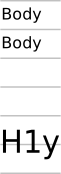
In the following example,
the height of line box in each paragraph is rounded up to the
step unit.
			:root {
			  font-size: 12pt;
			  --my-grid: 18pt;
			  line-height-step: var(--my-grid);
			}
			h1 {
			  font-size: 20pt;
			  margin-top: calc(2 * var(--my-grid));
			}
			p {
			  margin: 0;
			}
The line box in
<h1> does not fit into one
step unit
and thus occupies two,
but it is still centered within the two
step unit.
Authors can keep margins or other properties to be multiple of
step unit
using ''var()'' and ''calc()'' as in the example above.
If author prefers,
tools like Sass can make such declarations shorter.
		  $gu: 18px;

		  @function gu($n) {
		    @return $n * $gu;
		  }

		  h1 {
		    font-size: 20pt;
		    margin: gu(1.2) auto gu(1.8);
		  }
It is usually recommended to set the 'line-height' lower than
the
step unit.
The used line height can increase due to several factors such as
the use of 'vertical-align' or font fallback.