What is CSS
• Cascading Style Sheets
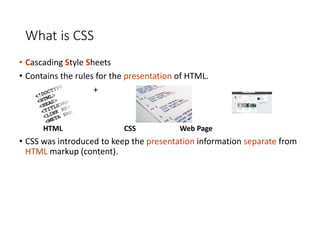
• Contains the rules for the presentation of HTML.
+ =
HTML CSS Web Page
• CSS was introduced to keep the presentation information separate from
HTML markup (content).
Before CSS
• Initially Designers used presentation tags like (FONT, B, BR, TABLE etc.) and
spacers GIFs to control the design of web pages.
• Any modification in the design of websites was a very difficult and
boring task , as it evolves manually editing every HTML page.
Providing support for multiple browsers was a
difficult task.
CSS – brief history
• Style sheets have existed in one form or another since the beginnings
of SGML in the 1970s.
• In 1996, CSS level 1 Recommendation was published in December.
• CSS level2 was published as a W3C Recommendation on May 12,
1998
• CSS level3
• level4 (I am coming….)
Sources of Styles
Author (developer) Styles
• Inline Styles - As inline attribute “style” inside HTML tags
<div style=“font-weight: bold;”>I am bold</div>
• Embedded Styles - As embedded style tag with in HTML document.
<html>
<head>
<title>Welcome to Vendio!</title>
<style>
.footer {
width:90%;
}
</style>
-------
</html>
• Linked Styles - Inside separate files with .css extension
<link rel="stylesheet" href=“external.css" type="text/css" />
Sources of Styles(contd.)
• User Style sheets
• Browser default style sheet(User agent)
• Web page style sheet
Cascade
The CSS cascade assigns a weight to
each style rule. When several rules
apply, the one with the greatest weight
takes precedence.
Order of preference for various styles:
• Default browser style sheet
(weakest)
• User style sheet
• Author style sheet
• Author embedded styles
• Author inline styles (strongest)
CSS Selectors
• ID based ( #)
HTML CSS
<div id=“content”> #content {
Text width: 200px;
</div> }
ID selectors should be used with single elements.
Class based selector
• Class (.)
HTML CSS
<div class=“big”> .content {
Text width: 200px;
</div> }
<div>
<span class=“big”>some text </span>
</div>
Class based styles can be used by multiple HTML elements.
We can add multiple class based selector by giving space
Eg: green big
Tag based selectors
• Tag (Tag name)
HTML CSS
<div> DIV {
Text width: 200px;
</div> }
<div> SPAN {
<span>some text </span> font-size:130%;
</div> }
<span>some other text </span>
Grouping
• Multiple selectors can be grouped in a single style declaration by
using , .
H1, P , .main {
font-weight:bold;
color:red;
}
P{
color:blue;
}
Descendant selectors
Descendant selectors are used to select elements that are
descendants (not necessarily children) of another element
in the document tree.
HTML CSS
<div class=“abc”> abc P {
<div> font-weight:bold;
<P> }
Hello there! </p>
</div>
</div>
Child selectors
A child selector is used to select an element that is a direct
child of another element (parent). Child selectors will not
select all descendants, only direct children.
HTML CSS
<div > DIV.abc > P {
<div class=“abc”> font-weight:bold;
<P> }
Hello there! </p>
</div>
</div>
Universal selectors
Universal selectors are used to select any element.
* {
color: blue;
}
Adjacent sibling selectors
Adjacent sibling selectors will select the sibling immediately following
an element.
DIV.abc + P {
font-weight: bold;
}
will work for
<div>
<div class=“abc”>Message</div>
<P>Hello there!</p>
</div>
Attribute selectors
Attribute selectors selects elements based upon the attributes
present in the HTML Tags and their value.
IMG[src="small.gif"] {
border: 1px solid #000;
}
will work for
<img sr
c=“small.gif” dir=“abc”/>
CSS Pseudo-classes
selector:pseudo-class { property: value }
:link
:visited } Link (A tag) related pseudo classes
:hover
:active
a:link {
color: #FF0000;
}
/* visited link */
a:visited {
color: #00FF00;
}
First-child,focus,disabled,checked and many more..
http://www.w3schools.com/css/css_pseudo_classes.asp
CSS Pseudo-element
selector::pseudo-element { property: value }
p::first-line {
color: #ff0000;
font-variant: small-caps;
}
h1::before {
content: url(smiley.gif);
}
http://www.w3schools.com/css/css_pseudo_elements.asp
CSS Values
• Words: text-align:center;.
• Numerical values: Numerical values are usually followed by a
unit type.
font-size:12px;
12 is the numerical value and px is the unit type pixels.
• Absolute Values – in, pc, px, cm, mm, pt
• Relative Values – em, rem, %,vw,vh
• Color values: color:#336699 or color#369.
Box model
http://www.w3schools.com/css/css_boxmo
del.asp
The Display Property
• Block Level elements, such as DIVs, paragraphs, headings, and lists, sit one
above another when displayed in the browser.
HTML
<body>
<div id=“div1”></div>
<div id=“div2”></div>
<div id=“div3”></div>
</body>
CSS
#div1 { width:300px;background:yellow;}
#div1 { width:300px;background:blue;}
#div1 { width:300px;background:orange;}
Inline Elements
• Inline elements such as a, span, and img, sit side by side when they are
displayed in the browser and only appear on a new line if there is
insufficient room on the previous one.
<div id="row1" >
<span class="norm">This is
small text and </span>
<span class="big">this is
big</span>
<span class="italicText"> I am
Italic</span>
</div>
.norm {
color:red;
}
.big {
color:blue;
font-weight:bold;
}
.italicText {
color:green;
font-style:italic;
}
#row1 {
padding:10px;
border:solid 1px #000;
}
Display property
none inline
block list-item
run-in compact
marker table
inline-table inline-block
table-row-group table-header-group
table-footer-group table-row
table-column-group table-column
table-cell
table-caption
FLEX
Visibility
Visible : The element is visible (default).
Hidden : The element is invisible (but still takes up space)
.big {
visibility:hidden;
}
Floating
float:left, right, none;
A floated box is laid out according to the normal flow, then taken out of the
flow and shifted to the left or right as far as possible.
IMG {
float:left;
}
Floating multiple elements
Floated boxes will move to the left or right until their outer edge
touches the containing block edge or the outer edge of another float.
<ul>
<li>Home</li>
<li>Products</li>
<li>Services</li>
<li>Contact Us</li>
</ul>
After applying
LI {
float:left;
}
Clearing Floats
Clear:both ;
Or
<style type="text/css">
.clearfix:after {
content: "."; display: block; height: 0; clear: both; visibility: hidden; }
.clearfix {display: inline-block;} /* for IE/Mac */
</style>
<!--[if IE]><style type="text/css">
.clearfix { zoom: 1; display: block; }
</style> <![endif]-->
Positioning - static
position:static; (Default option) the element occurs in the normal flow
(ignores any top, bottom, left, right, or z-index declarations)
Positioning - relative
position:relative; Generates a relatively positioned element, positioned
relative to its normal position, use bottom, right, top and left property
to place element. Default flow of other elements don’t change.
Positioning - absolute
position:absolute; Generates an absolutely positioned element,
positioned relative to the first parent element that has a position other
than static (if none is found, relative to document’s BODY). use bottom,
right, top and left property to place element
Positioning - fixed
position: fixed; A fixed element is positioned relative to the viewport,
which means it always stays in the same place even if the page is
scrolled.
z-index
The z-index property specifies the stack order of an element.
An element with greater stack order is always in front of an
element with a lower stack order.
only works on positioned elements (position:absolute,
position:relative, or position:fixed).
Inheritance
• Styles that relate to text and appearance are inherited by the
descendant elements.
• Styles that relate to the appearance of boxes created by styling DIVs,
paragraphs, and other elements, such as borders, padding, margins
are not inherited.
https://www.w3.org/TR/CSS21/propidx.html
Refrences
• www.w3schools.com
• www.w3.org
• World wide web

css v1 guru

  • 1.
    What is CSS •Cascading Style Sheets • Contains the rules for the presentation of HTML. + = HTML CSS Web Page • CSS was introduced to keep the presentation information separate from HTML markup (content).
  • 2.
    Before CSS • InitiallyDesigners used presentation tags like (FONT, B, BR, TABLE etc.) and spacers GIFs to control the design of web pages.
  • 3.
    • Any modificationin the design of websites was a very difficult and boring task , as it evolves manually editing every HTML page.
  • 4.
    Providing support formultiple browsers was a difficult task.
  • 5.
    CSS – briefhistory • Style sheets have existed in one form or another since the beginnings of SGML in the 1970s. • In 1996, CSS level 1 Recommendation was published in December. • CSS level2 was published as a W3C Recommendation on May 12, 1998 • CSS level3 • level4 (I am coming….)
  • 6.
    Sources of Styles Author(developer) Styles • Inline Styles - As inline attribute “style” inside HTML tags <div style=“font-weight: bold;”>I am bold</div> • Embedded Styles - As embedded style tag with in HTML document. <html> <head> <title>Welcome to Vendio!</title> <style> .footer { width:90%; } </style> ------- </html> • Linked Styles - Inside separate files with .css extension <link rel="stylesheet" href=“external.css" type="text/css" />
  • 7.
    Sources of Styles(contd.) •User Style sheets • Browser default style sheet(User agent) • Web page style sheet
  • 8.
    Cascade The CSS cascadeassigns a weight to each style rule. When several rules apply, the one with the greatest weight takes precedence. Order of preference for various styles: • Default browser style sheet (weakest) • User style sheet • Author style sheet • Author embedded styles • Author inline styles (strongest)
  • 9.
    CSS Selectors • IDbased ( #) HTML CSS <div id=“content”> #content { Text width: 200px; </div> } ID selectors should be used with single elements.
  • 10.
    Class based selector •Class (.) HTML CSS <div class=“big”> .content { Text width: 200px; </div> } <div> <span class=“big”>some text </span> </div> Class based styles can be used by multiple HTML elements. We can add multiple class based selector by giving space Eg: green big
  • 11.
    Tag based selectors •Tag (Tag name) HTML CSS <div> DIV { Text width: 200px; </div> } <div> SPAN { <span>some text </span> font-size:130%; </div> } <span>some other text </span>
  • 12.
    Grouping • Multiple selectorscan be grouped in a single style declaration by using , . H1, P , .main { font-weight:bold; color:red; } P{ color:blue; }
  • 13.
    Descendant selectors Descendant selectorsare used to select elements that are descendants (not necessarily children) of another element in the document tree. HTML CSS <div class=“abc”> abc P { <div> font-weight:bold; <P> } Hello there! </p> </div> </div>
  • 14.
    Child selectors A childselector is used to select an element that is a direct child of another element (parent). Child selectors will not select all descendants, only direct children. HTML CSS <div > DIV.abc > P { <div class=“abc”> font-weight:bold; <P> } Hello there! </p> </div> </div>
  • 15.
    Universal selectors Universal selectorsare used to select any element. * { color: blue; }
  • 16.
    Adjacent sibling selectors Adjacentsibling selectors will select the sibling immediately following an element. DIV.abc + P { font-weight: bold; } will work for <div> <div class=“abc”>Message</div> <P>Hello there!</p> </div>
  • 17.
    Attribute selectors Attribute selectorsselects elements based upon the attributes present in the HTML Tags and their value. IMG[src="small.gif"] { border: 1px solid #000; } will work for <img sr c=“small.gif” dir=“abc”/>
  • 18.
    CSS Pseudo-classes selector:pseudo-class {property: value } :link :visited } Link (A tag) related pseudo classes :hover :active a:link { color: #FF0000; } /* visited link */ a:visited { color: #00FF00; } First-child,focus,disabled,checked and many more.. http://www.w3schools.com/css/css_pseudo_classes.asp
  • 19.
    CSS Pseudo-element selector::pseudo-element {property: value } p::first-line { color: #ff0000; font-variant: small-caps; } h1::before { content: url(smiley.gif); } http://www.w3schools.com/css/css_pseudo_elements.asp
  • 20.
    CSS Values • Words:text-align:center;. • Numerical values: Numerical values are usually followed by a unit type. font-size:12px; 12 is the numerical value and px is the unit type pixels. • Absolute Values – in, pc, px, cm, mm, pt • Relative Values – em, rem, %,vw,vh • Color values: color:#336699 or color#369.
  • 21.
  • 22.
    The Display Property •Block Level elements, such as DIVs, paragraphs, headings, and lists, sit one above another when displayed in the browser. HTML <body> <div id=“div1”></div> <div id=“div2”></div> <div id=“div3”></div> </body> CSS #div1 { width:300px;background:yellow;} #div1 { width:300px;background:blue;} #div1 { width:300px;background:orange;}
  • 23.
    Inline Elements • Inlineelements such as a, span, and img, sit side by side when they are displayed in the browser and only appear on a new line if there is insufficient room on the previous one. <div id="row1" > <span class="norm">This is small text and </span> <span class="big">this is big</span> <span class="italicText"> I am Italic</span> </div> .norm { color:red; } .big { color:blue; font-weight:bold; } .italicText { color:green; font-style:italic; } #row1 { padding:10px; border:solid 1px #000; }
  • 24.
    Display property none inline blocklist-item run-in compact marker table inline-table inline-block table-row-group table-header-group table-footer-group table-row table-column-group table-column table-cell table-caption FLEX
  • 25.
    Visibility Visible : Theelement is visible (default). Hidden : The element is invisible (but still takes up space) .big { visibility:hidden; }
  • 26.
    Floating float:left, right, none; Afloated box is laid out according to the normal flow, then taken out of the flow and shifted to the left or right as far as possible. IMG { float:left; }
  • 27.
    Floating multiple elements Floatedboxes will move to the left or right until their outer edge touches the containing block edge or the outer edge of another float. <ul> <li>Home</li> <li>Products</li> <li>Services</li> <li>Contact Us</li> </ul> After applying LI { float:left; }
  • 28.
    Clearing Floats Clear:both ; Or <styletype="text/css"> .clearfix:after { content: "."; display: block; height: 0; clear: both; visibility: hidden; } .clearfix {display: inline-block;} /* for IE/Mac */ </style> <!--[if IE]><style type="text/css"> .clearfix { zoom: 1; display: block; } </style> <![endif]-->
  • 29.
    Positioning - static position:static;(Default option) the element occurs in the normal flow (ignores any top, bottom, left, right, or z-index declarations)
  • 30.
    Positioning - relative position:relative;Generates a relatively positioned element, positioned relative to its normal position, use bottom, right, top and left property to place element. Default flow of other elements don’t change.
  • 31.
    Positioning - absolute position:absolute;Generates an absolutely positioned element, positioned relative to the first parent element that has a position other than static (if none is found, relative to document’s BODY). use bottom, right, top and left property to place element
  • 32.
    Positioning - fixed position:fixed; A fixed element is positioned relative to the viewport, which means it always stays in the same place even if the page is scrolled.
  • 33.
    z-index The z-index propertyspecifies the stack order of an element. An element with greater stack order is always in front of an element with a lower stack order. only works on positioned elements (position:absolute, position:relative, or position:fixed).
  • 34.
    Inheritance • Styles thatrelate to text and appearance are inherited by the descendant elements. • Styles that relate to the appearance of boxes created by styling DIVs, paragraphs, and other elements, such as borders, padding, margins are not inherited. https://www.w3.org/TR/CSS21/propidx.html
  • 36.